



Healthcare branding is the strategic process of shaping how patients perceive a healthcare organization through its visual identity, messaging, values, and the overall patient experience. In the AI era, it shapes trust, credibility, and emotional connection at every touchpoint, from a clinic’s website to an in-person visit.
In fact, according to the Edelman Trust Barometer, 63% of people say they will only choose brands they trust, even when cheaper alternatives exist. If you’re a healthcare organization, you should not ignore this signal. That number matters for hospitals and clinics too: a clear healthcare branding strategy builds patient confidence long before a first appointment.
This guide covers medical brand identity development and the best practices for earning lasting patient confidence.
Why Every Healthcare Organization Needs a Clear Brand Strategy
A clear brand strategy keeps healthcare messaging consistent and builds patient trust. It also helps organizations stand out in a highly competitive market. Let’s take a closer look:
- Patients trust brands they recognize; a clear healthcare branding strategy builds that recognition across every website, sign, and consultation.
- Without a strong corporate identity for healthcare organizations, patients face mixed messaging that erodes confidence before the first appointment.
- Brand image is one of the strongest predictors of patient loyalty and outpatient revisit decisions, a systematic review in Journal of Applied Nursing and Health found.
- Inconsistent visuals and tone across channels weaken healthcare brand awareness growth and make competitors look more credible by default.
- A defined healthcare brand positioning strategy helps patients choose a provider faster and reduces decision fatigue during stressful moments.
- Medical brand differentiation matters most in saturated markets, where patients cannot tell one clinic’s expertise from another’s.
The Key Components of a Memorable Healthcare Brand Identity
A healthcare brand identity is built from several elements, and each one shapes how patients form trust before they hear a diagnosis.
Visual identity
The logo, color palette, and typography are the first cues patients notice, on a website, a sign, or an appointment reminder email.
A hospital using calming blues and clean sans-serif type signals order and care, while cluttered visuals suggest disorganization. This is where brand identity design decisions carry the most weight.
Brand Voice
The words a provider uses in patient portals, discharge instructions, and social posts carry a tone.
A pediatric clinic writing in warm, plain language builds different trust than a surgical center using clinical precision. Voice consistency is one output of thorough medical brand identity development.
Brand Values
Patients want to know what a provider stands for, whether that’s affordability, specialization, or bedside manner.
Values guide every later branding decision, from which case studies to publish to how staff greets patients at intake.
Imagery and Photography
Real patients and staff photographed in real settings build more credibility than generic stock photos. This ties directly into broader brand design choices across a website and print materials.
Messaging Hierarchy
A clear headline, supporting explanation, and call to action on every page reduce confusion for patients booking appointments.
Together, these elements form the corporate identity for healthcare organizations, and skipping even one weakens the rest.
Best Branding Practices for Building a Strong Healthcare Brand Strategy
You can only do branding for your healthcare organization by showing up consistently in daily decisions, not just in a style guide.
The practices below turn brand theory into actions that patients notice:
- How a clinic explains its value
- How staff communicates
- How consistent the experience feels from the first Google search to the follow-up call
Each practice below builds on the last, and together they shape whether a patient chooses one provider over another.
| Practice | Why It Matters for Strengthening the Brand |
| Define a clear value proposition | Tells patients what makes this provider different within seconds of arriving on a page. |
| Build a consistent brand identity | Repeated visuals and messaging across channels make a provider easier to recognize and trust. |
| Develop an authentic brand voice | A steady, human tone reduces patient anxiety and builds rapport before an appointment. |
| Publish expert, evidence-based content | Accurate health information positions a provider as a credible authority, not just a service. |
| Showcase real patient outcomes | Verified testimonials and case studies reduce uncertainty for patients comparing providers. |
| Highlight accreditations and compliance | Visible credentials and HIPAA compliance reassure patients about safety and legitimacy. |
| Create a patient-centered visual identity | Real photography over stock images makes the brand feel closer to actual care. |
| Deliver a consistent patient experience | Every touchpoint, from booking to follow-up, either confirms or contradicts the brand promise. |
| Build a scalable color system | A structured palette keeps recognition strong as the brand expands across new channels. |
| Personalize digital communication | Relevant, patient-specific outreach builds trust faster than generic messages sent to every patient. |
Define a Clear Healthcare Value Proposition
A healthcare value proposition states, in one or two sentences, why a patient should choose a specific provider over other visible options. It has to promise a concrete benefit patients can recognize.
Strong value propositions typically:
- Name the patient’s problem directly, using the language patients use in search or consultations.
- Explain what this provider does differently, such as a focused specialty, extended hours, or clear follow-up protocols.
- Point to proof, like outcomes data, wait-time commitments, or recognized credentials that support the claim.
Getting this right is a core part of medical brand differentiation, because most patients will not read an entire site before deciding. Many teams rely on healthcare branding services to test this message with real patients so branding for healthcare earns trust from the first line.
Build a Consistent Brand Identity Across Every Patient Touchpoint
Patients interact with a healthcare brand across many surfaces: a website, a Google Business profile, email reminders, the waiting room, and the visit itself. If tone or visuals shift between these, patients feel something is off, even if they cannot explain why.
Consistency across key touchpoints means:
- The website and online profiles use the same logo, color system, and naming.
- Email and SMS reminders match the voice patients see on the site.
- Physical spaces, signage, and printed materials follow shared visual rules.
- Front-desk scripts and clinical documents use aligned wording and titles.
- Social and educational content reinforce the same healthcare branding story.
The development of a consistent healthcare brand identity turns one positive visit into ongoing healthcare brand awareness growth, because patients can recognize and recommend a brand they trust. Many providers update brand experience design and workflows together to prevent departments from drifting into separate styles.
Schedule a Free Call
Develop an Authentic Brand Voice That Inspires Patient Confidence
Brand voice is the personality behind the words: how a provider writes appointment reminders, answers reviews, or explains a diagnosis on its website. A pediatric clinic might sound warm and reassuring.
A surgical center might sound precise and calm. Neither tone is wrong, but it has to stay the same everywhere.
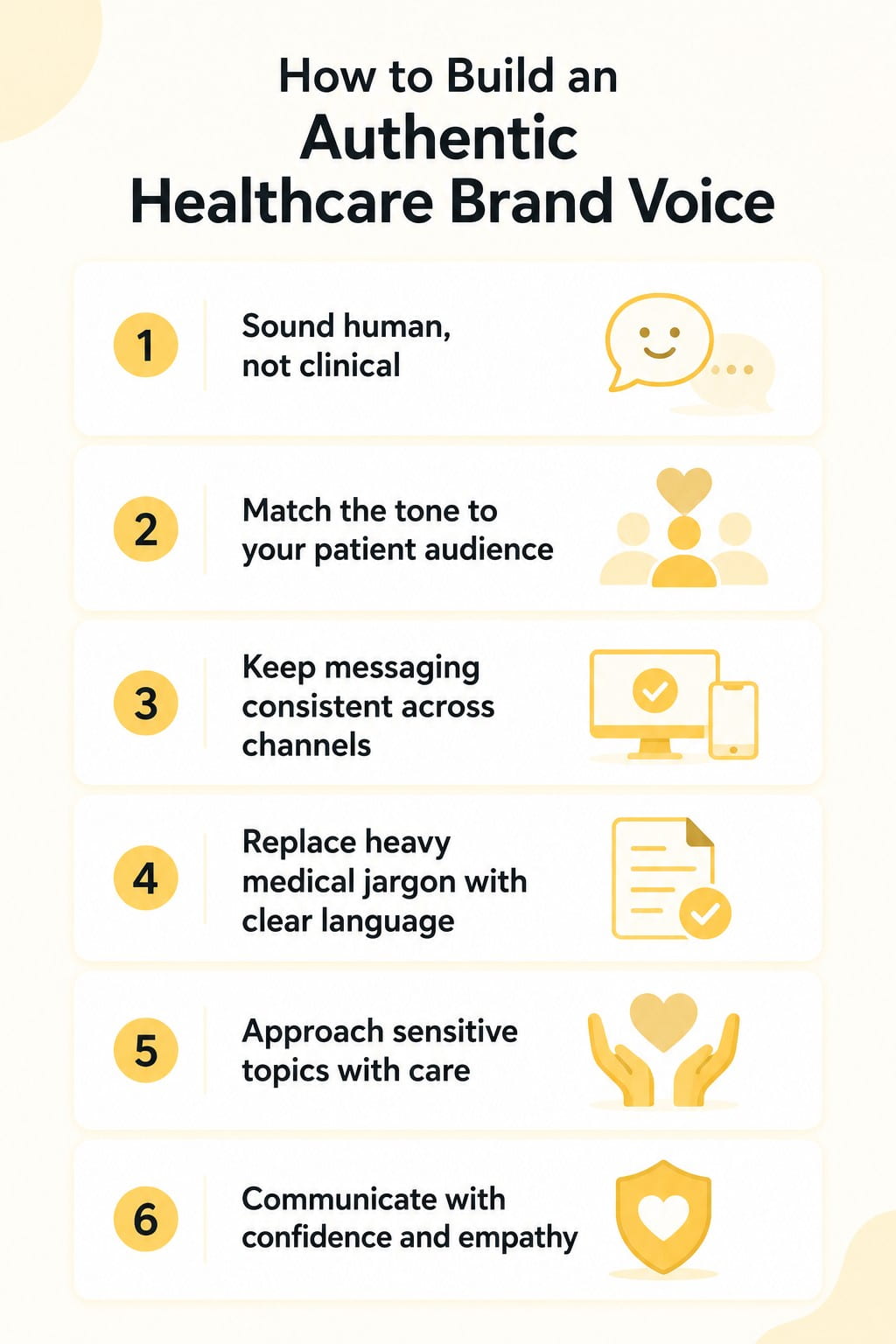
A clear healthcare brand messaging strategy sets rules for this voice: which words to avoid (like heavy jargon), how formal to sound, and how to talk about sensitive topics without sounding clinical or cold.
Patients read tone as a signal of competence, so a voice that feels rushed or generic reads as less trustworthy, even if the care itself is excellent.
This voice needs to carry across digital branding efforts too, from chatbot replies to social captions, since a mismatched tone on one channel undercuts confidence built everywhere else.
Build Trust Through Medical Expertise and Educational Content
Patients trust doctors more than any other source of health information: 83% name their own physician as their most trusted source, according to a patient experience survey by TechTarget.
That trust does not transfer automatically to a brand; it has to be earned through content that reflects real medical expertise. Publishing accurate treatment guides, preventive care resources, and plain-language explanations of conditions builds this authority over time.
Google also treats medical content as a “Your Money or Your Life” topic, holding it to stricter accuracy standards than most industries, which rewards well-sourced, regularly updated pages.
Corporate identity for healthcare organizations depends on this credibility as much as visuals do.
A well-designed website matters too, since even accurate content underperforms on a confusing healthcare web design that buries key information.
Showcase Patient Testimonials, Success Stories, and Real Outcomes
Uncertainty is one of the biggest barriers to booking with an unfamiliar provider. Specific patient stories reduce that uncertainty faster than any generic list of services.
| Element | Good practice | Risk if done poorly |
| Outcome detail | Describe a clear change, such as recovery time, symptom relief, or improved mobility. | Vague praise like “great staff” that could apply to any provider. |
| Structure | Use a simple arc: patient problem, intervention, measurable result. | Long narratives that feel promotional or hard to follow. |
| Evidence | Where possible, connect outcomes to data or recognized clinical standards. | Claims that cannot be traced to documented care. |
| Consent and privacy | Obtain written consent; anonymize when needed; follow HIPAA and local rules. | Publishing stories without consent or identifiable details patients did not agree to share. |
Handled carefully, testimonials and case studies support both credibility and medical brand differentiation without revealing more than a patient has agreed to share.
Highlight Accreditation, Certifications, and Compliance Standards
Accreditations, board certifications, and compliance badges answer a question patients often cannot check themselves: is this provider qualified and safe to trust?
| Credential | Where to show it | What it communicates |
| Joint Commission or equivalent accreditation | Hospital or clinic overview pages; footer | The facility meets recognized quality and safety standards. |
| Physician board certifications | Individual doctor bios; specialist service pages | Clinicians have proven expertise in their field. |
| HIPAA and data protection compliance notices | Patient portal, privacy pages, site footer | Patient information is handled under clear legal and security rules. |
| Awards and professional recognition | “About” page; dedicated awards section | Peers and independent bodies recognize the provider’s performance. |
A strong healthcare brand positioning strategy treats these signals as proof points, not decoration. Healthcare branding earns more trust when confident claims about care sit next to the credentials that support them.
Create a Patient-Centered Visual Identity
Generic stock photos of smiling models in white coats no longer convince patients of anything. A patient-centered visual identity uses real photography of actual staff and, with consent, real patients, showing genuine interactions instead of staged ones.
Accessibility matters as much as authenticity here. Color contrast, readable font sizes, and alt text for images make a website usable for patients with low vision or cognitive differences, which is a meaningful part of medical brand identity development that many healthcare sites still skip.
Custom illustrations can fill gaps where real photography isn’t practical, such as explaining a procedure step by step, but they should match the same tone as the photography rather than feel like a separate style.
This attention to detail is what makes branding for healthcare feel considered rather than templated, and it strengthens recognition the same way consistent messaging does.
Deliver a Consistent Patient Experience That Supports Your Brand Promise
A brand promise has to match what patients experience. A website may promise “compassionate, fast care,” but patients will judge that claim when they book an appointment, arrive at reception, speak with staff, and receive follow-up communication.
Review consistency across the full patient experience:
- Booking: Is it quick to find an appointment type, provider, and available time?
- Pre-visit communication: Do emails, reminders, and phone calls set clear expectations?
- Arrival and check-in: Do staff, signage, and forms feel organized and considerate?
- Care delivery: Does the provider’s communication reflect the tone promised in marketing?
- Follow-up: Do patients receive timely instructions, results, and next-step guidance?
The development of a consistent healthcare brand identity extends into staff training and workflow decisions. Healthcare branding earns repeat visits and referrals when the patient experience matches the promise at every touchpoint.
Build a Scalable Color System for Strong Brand Recognition
Color is often the fastest way a patient recognizes a brand, faster than a logo shape or a tagline.
A scalable color system defines a primary palette, secondary accents, and clear rules for when each color applies, so a new landing page or app screen still looks like the same organization a year later.
Accessibility has to be built in from the start: color contrast ratios need to work for patients with visual impairments, not just look appealing on a designer’s screen. A hierarchy also matters, with one dominant color for trust and calm, and accent colors reserved for calls to action like booking a visit.
Getting this system right supports long-term healthcare brand awareness growth, since patients start associating specific colors with specific care experiences across every platform the brand touches.
Personalize Digital Communication Across the Patient Journey
Generic mass emails feel out of place when patients expect care tailored to them. Personalized communication shows the brand is paying attention, not just pushing information.
Useful personalization tactics include:
- Segmenting outreach by condition, age group, or service line.
- Writing appointment reminders that reference visit type and location.
- Sending follow-up content matched to a patient’s diagnosis or procedure.
- Adjusting timing based on behavior, such as missed appointments or unopened emails.
Providers using behavioral and demographic data to personalize outreach see stronger engagement than those sending identical messages to every patient, because relevance drives opens and responses more than design alone.
This is where a healthcare brand messaging strategy earns its value: the tone stays consistent, while messages adapt to each patient’s stage of care.
Healthcare Branding Checklist: How to Measure Your Success
Use this checklist to evaluate whether your branding strategy is actually working, not just looking polished on paper.
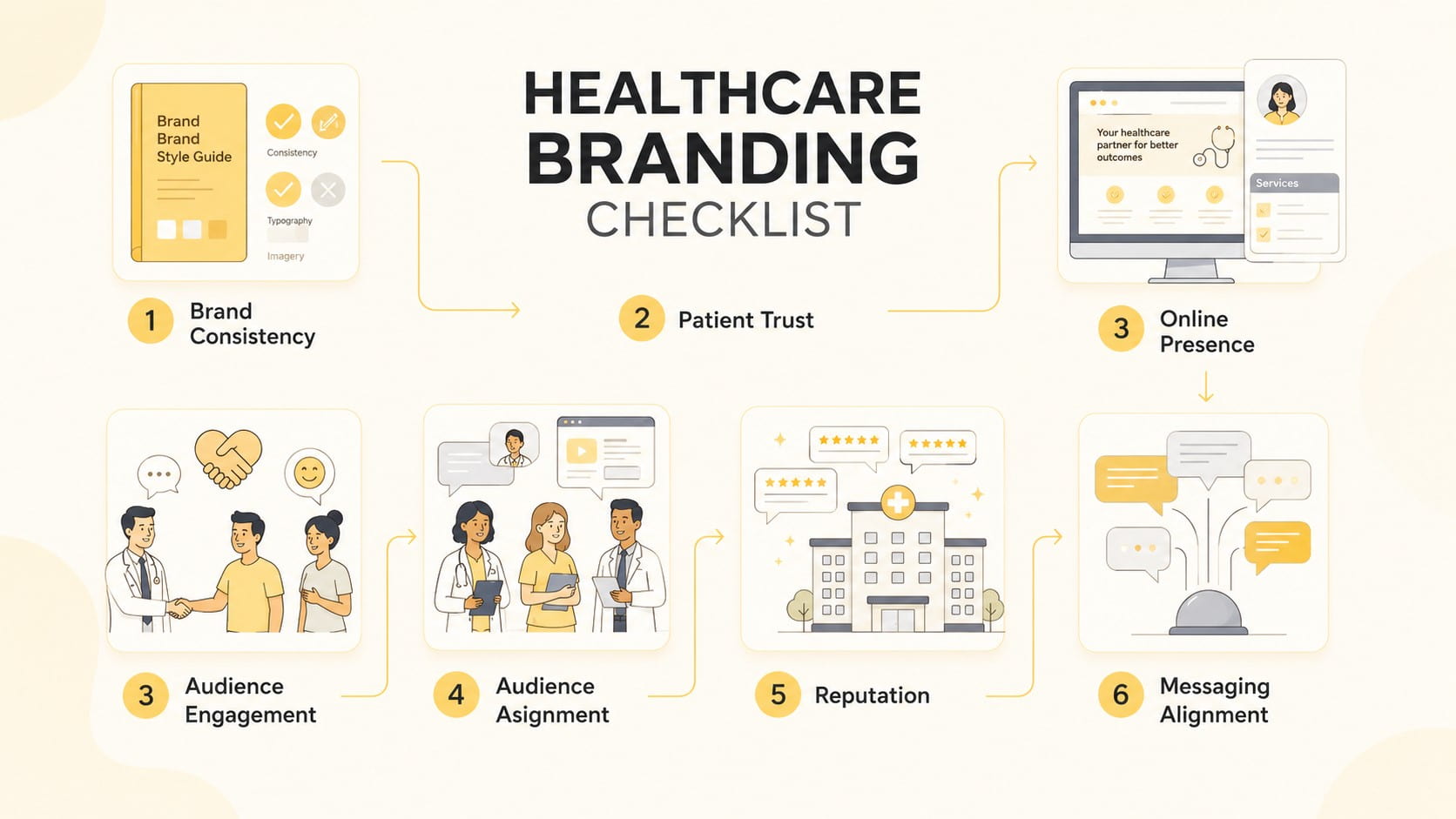
- Brand consistency: Do logo, color, and voice match across the website, clinic, and social channels?
- Patient trust: Are testimonials, credentials, and accreditations visible and easy to find?
- Online presence: Does the brand rank for relevant searches and appear correctly in AI-generated answers?
- Audience engagement: Are patients commenting, sharing, or responding to content, not just scrolling past it?
- Reputation: Do review scores and mentions reflect the healthcare brand positioning the organization is aiming for?
- Messaging-experience alignment: Does the actual patient visit match what the brand promises online?
Branding in healthcare succeeds when the development of a consistent healthcare brand identity shows up in every one of these areas, not just a few.
Conclusion
Healthcare branding is the work of aligning value proposition, visual identity, brand voice, and patient experience into one coherent story patients can trust.
When medical brand identity development is grounded in evidence-based content and consistent touchpoints, it strengthens recognition and patient loyalty rather than just refreshing a logo.
Use the checklist to audit brand consistency, healthcare brand messaging strategy, and digital presence regularly, so branding stays clear, trustworthy, and in step with real care outcomes.