

In 2025, only about two out of 10 companies plan to increase their budget for experience design, according to the UX Trends Report 2025. To add to the challenge, it’s not as if you can use last year’s budget again. In fact, most companies expect to have less funds allocated this year.
Only 36% of companies expect their budget for experience design to stay the same in 2026.
Companies’ reluctance to increase their spending on user experience (UX) design shouldn’t be seen as a sign that it no longer matters, though. The same report found that a massive 84% believe that it will become even more popular in the next 10 years ( especially in the healthcare industry), underscoring the importance of UX design.
Here’s a look at pricing factors and average costs to help you make sense of UI/UX costs and face the anticipated budget constraints going forward. Then, use the few “life hacks” shared to stretch your budget further.
Factors That Influence the Pricing of UI/UX Design
From research to revisions, there are various factors that can impact UI/UX pricing. Here are the main considerations when you’re shopping around for price.
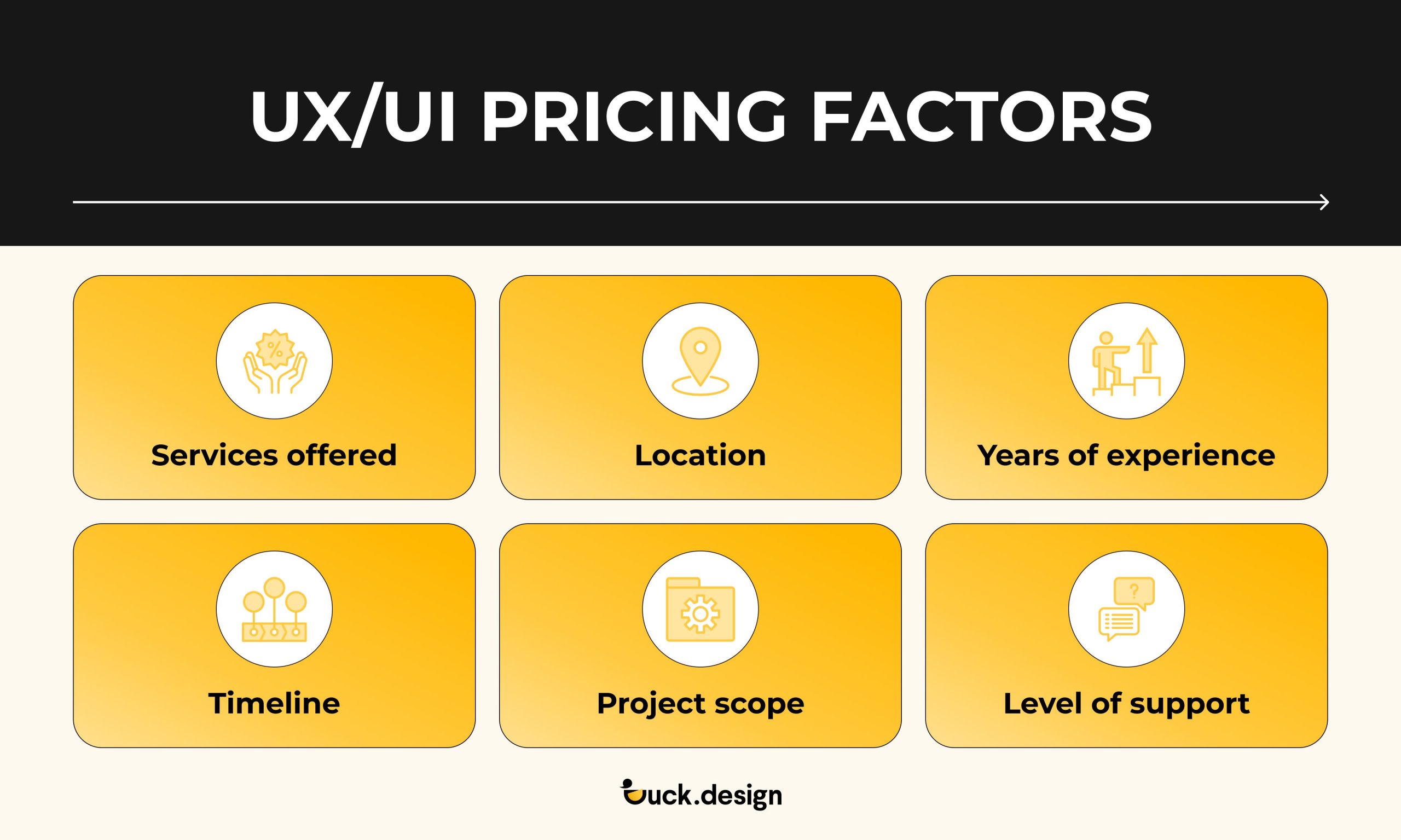
Services included
The services included in the UI/UX package will have a huge impact on the price. If you need more services or have more complex needs, you can expect to pay more.
In fact, depending on your needs, it might make more financial sense to pay for services individually. For example, if you’re simply redesigning an existing app, you can likely skip user research and competitive analysis.
Location
Factors like the cost of living, market demand and supply, labor laws, and tax implications can make working with an agency or freelancer based in a specific city more expensive.
For example, according to an article published on Medium, San Francisco is rated as the most expensive city in the US for UX/UI design. Here, rates can be about $30 more than the average hourly rate.
It’s not just in the United States, but a trend seen in other countries across the world too. For example, in London, designers also have to charge more to cover their higher cost of living.
Designer experience
Senior designers typically charge more than their junior colleagues. You’ll essentially be paying for their reputation and expertise which they’ve had a longer time to refine.
In fact, you might be charged more per hour, but they’ll likely need fewer hours as their experience means they can make better decisions faster. This means that the result will be higher quality work that requires fewer revisions.
Timeline
A tight deadline will likely mean that your designers will put in some overtime. The agency might also have to assign more designers to your project in order to hit that deadline. This could incur you extra fees which will drive up the cost.
Complexity and scope
If you need only a couple of screens and a simple layout, you can expect to pay less. However, as soon as you start to add integrations, interactive elements, custom design, and advanced features, the price starts to increase.
Not only will complex projects take more time to complete, but also call for more experienced designers. Hence, you’ll be paying more because of the hours as well as the advanced skills needed.
The same applies to the project scope. If you need to conduct comprehensive research that involves surveys and design detailed wireframes, your design team will have more billable hours.
Revisions and support
Not all UI/UX packages include support after your project gets launched. You might need to update your design or gather more user feedback for which you can be charged separately.
Some agencies might also cap the number of revisions during their UI/UX design process. If you need more revisions than what their Ts and Cs allowed for, you’ll be billed extra.
Schedule a Meeting
Average UI/UX Design Costs Based on Real Data
In general, you’re unlikely to be able to get away with spending less than $10,000 on your UX project. That said, according to data shared by Clutch, it can just as easily cost you closer to $50,000.

Source: Clutch
If it’s for an agency project, you can expect to pay nearly double that. Based on their reviews, the average cost for a UX agency project is nearly $85,000.
While many agencies will have a set minimum project fee, it’s not uncommon for them to charge an hourly rate for work like usability testing, user research, or UX strategy that falls outside of the traditional design work. If this is the preferred pricing structure, you can budget between $100 and $149 per hour in the US.
Compared to agencies, freelancers in the US tend to charge less per hour. According to data shared by Upwork, there’s not much difference between UI vs UX pricing. If you’re purely interested in hiring a UI designer, hourly rates start at about $40 per hour, while UX designers typically charge no more than $40 per hour.

Source: Upwork
Services like visual design are slightly less expensive, with the average hourly rate maxing out at $90. However, for interactive design or interface layout/design, it can exceed $100 per hour, putting them in range of the average agency rate.
You can also expect to pay more for specialized areas like responsive UI/UX design for apps. For example, according to cost data about mobile app design shared by GoodFirms, a simple mobile app will cost you about $12,000, while a sophisticated one will set you back over $80,000.
As for the hourly rates, agencies can charge as much as $200 per hour for uncomplicated apps, while a high-end app could cost you as much as $400 per hour.
Once again, freelancers can be significantly cheaper. According to data shared by Upwork, a freelance UI/UX designer will charge between $30 and $70 per hour to design the look and feel of your mobile app.
That said, there are many factors that can impact this pricing, as mentioned earlier. As such, the following data for UI/UX costs in the United States should be seen as estimates only.
| Agencies | Freelancers | |
| Average hourly rate | Between $100 and $149 | Between $20 and $40 |
| Average hourly rate for mobile UX design | Between $200 and $400 | Between $30 and $70 |
Important Considerations for Planning a UI/UX Budget
In addition to considering factors like the designers’ location and your timeline, you’ll also need to keep the following in mind when you budget for your project. Here are three top considerations that can help you to save money too.
Your business goals
As the data show, UX/UI services are a significant investment. That’s why it’s so important that you first understand the typical components before you allocate a slice of your budget.
Then, prioritize the areas where you want to spend based on your business goals. For example, by linking specific services directly to a KPI like conversion rate, your budget goes toward a relevant outcome that matters.
It can also be a good idea to involve stakeholders early on in this process. Getting input from your marketing, product, and development teams help to ensure alignment from the start.
Users
Thorough user research is an expense you’ll gladly want to pay as it can save you money in the long run. When you understand your users’ behaviour and their pain points early on, you can avoid expensive redesigns later.

Another good practice is to test early and often. Usability testing can reveal big issues early, once again helping you to prevent costly surprises.
That said, even when you’ve tested frequently at the beginning, you should still expect and plan for changes. However, these will rather be small iterations as opposed to big costly changes because your early user research and testing ensured that your design solved pain points.
Individual vs comprehensive solutions
Whether you’re planning to outsource UI/UX design to an agency or a freelancer, you’ll likely be asked to choose between paying for individual services or a full-service package. Each route offers unique pros and cons which could affect your UI/UX design costs.
For example, individual services’ custom costs are lower upfront. However, it’s more difficult to ensure integrated UI/UX patterns which could cause your design to end up missing the big picture.
While opting for a comprehensive solution will mean you’ll likely pay for everything from UI/UX strategy to ongoing maintenance costs which will drive up the upfront costs and extend the timeline, it often ends up being the more cost-effective solution in the long run. That’s because you’ll get consistency, one of the key UI design principles, and better user flow. It will be much easier for the team assigned to your project to apply a holistic design vision across all touchpoints.
UI/UX Agency vs Freelance Designer: What’s More Cost-Effective?

True, freelancers typically charge less than agencies. However, it doesn’t necessarily equate to cost-effectiveness in the long run.
Agencies may have higher rates due to their team, resources, and overheads, but they offer a more comprehensive approach and scalability for large projects. As a whole team will be able to work on your project, you’ll be able to access more services and deeper expertise.
A freelancer might be highly skilled in one area. However, it’s highly unlikely that they can match that level of expertise across different areas. As such, you might lack the breadth of expertise needed for complex or ongoing projects.
The fact that an agency also has more time that they can dedicate to your project can also make their services more cost-effective. The sooner you can get your website or app to go live, the sooner you can start to see results.
On the topic of time, you’ll also need to consider that when you decide to work with a freelancer, you’ll essentially need to manage them. This can cut into your time, making it less cost-effective.
At the end of the day, for long-term projects and high-quality results, an agency will likely be the more cost-effective choice.
Call Us
Get High-Quality UI/UX Design Through Duck.Design’s Subscription Plans
Duck.Design’s experts can design complex, intuitive user interfaces for various user groups that intertwine best practices in accessibility and usability. Not only do we know how to incorporate standard practices, but our experience has taught us how and when to adjust these guidelines so that your user experience is familiar, yet unique.
At Duck.Design, we believe that to create user-centered design you need to apply data-driven design. We go beyond merely design to include data collection and analytics too.
What’s more, as app design is at the core of several of our services, our multi-disciplinary team can also design an intuitive app. This way, you can allow even more opportunities for customers to interact with your product.
Not only should good design focus on accessibility, but it should also be within reach of businesses. We’ve designed our subscription plans for our UI/UX design services to allow our clients to increase their output without the added expense of overhead costs. It’s cost-effective as well as comprehensive and includes a variety of other related services such as:
- Graphic design
- Brand identity design
- Website and landing page design
- SaaS product design
- Illustrations and motion graphics