



Key Findings
- AI branding tools improve workflows but do not replace strategic decisions.
- Strong brand identities depend on human evaluation of AI-generated ideas.
- AI creates stronger branding outcomes when workflows connect automation with human decision-making.
- AI accelerates creative exploration when brand strategy defines the evaluation criteria.
- Brand consistency requires clear systems beyond AI-generated outputs.
Artificial intelligence has changed branding workflows by accelerating research, ideation, and content development. The best branding tools do not replace strategic decisions. They help teams explore possibilities, organize information, and create more consistent brand systems.
Modern branding requires more than producing visual assets or generating content variations. Companies need a clear understanding of their audience, positioning, and communication goals before using AI effectively. Without this foundation, AI can create more options without creating a stronger identity.
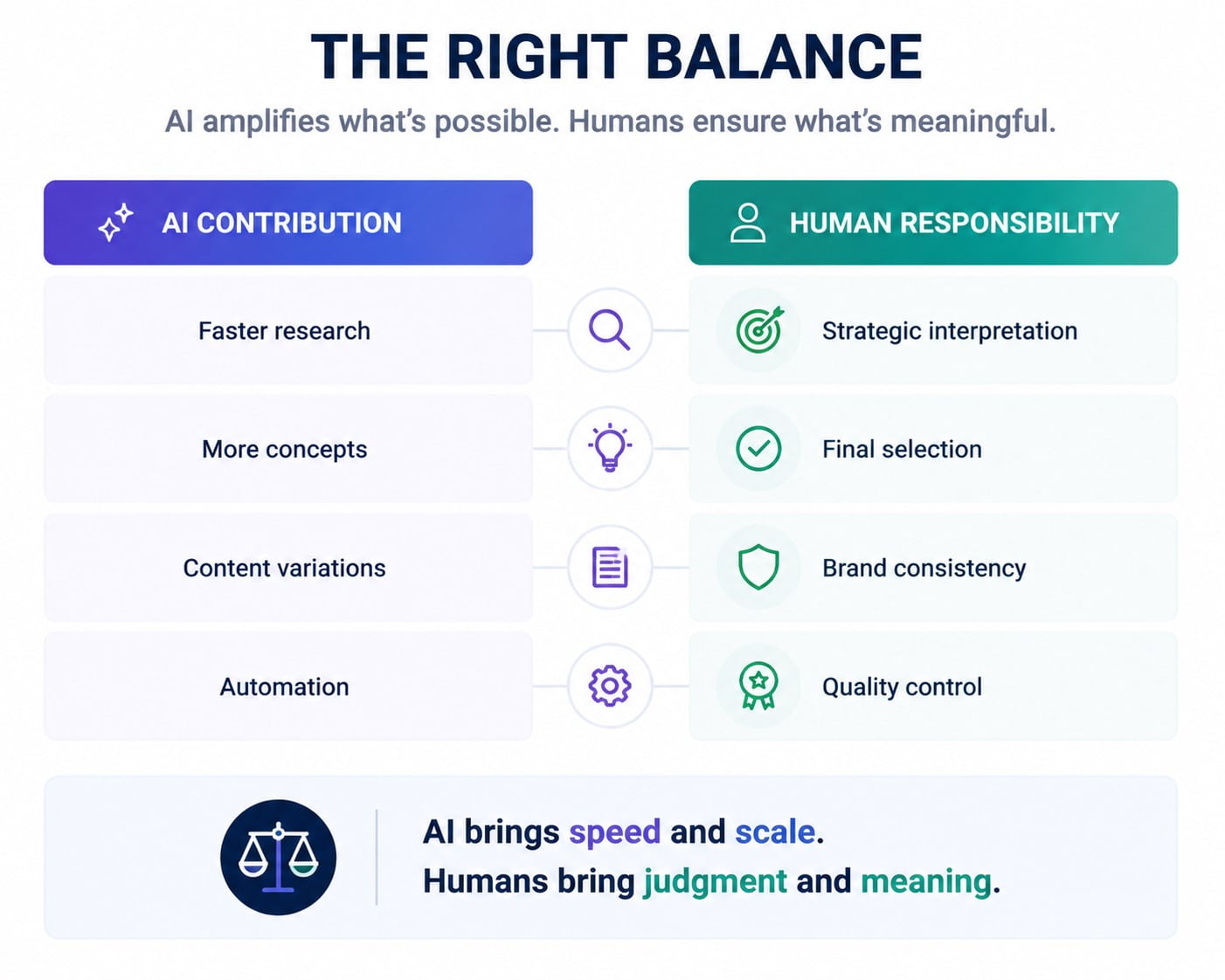
AI-supported branding works best when technology improves workflows. People remain responsible for judgment, differentiation, and final decisions. The goal is not to automate the entire branding process, but to make each stage more efficient and informed.
What Is AI Branding?
Artificial intelligence for branding helps companies support brand research, strategy, identity creation, messaging, and content development through AI-assisted workflows. These tools analyze information, generate creative directions, and help teams manage repetitive branding tasks more efficiently.
Traditional branding relies heavily on manual research, creative exploration, and specialist expertise. AI branding adds new capabilities by helping teams process larger amounts of information, test more ideas, and accelerate early-stage development.
AI can support many parts of the process, including:
- audience and market research;
- messaging exploration;
- visual concept development;
- content adaptation;
- brand consistency management.
However, AI cannot determine which ideas support business goals. Human teams still need to evaluate meaning, relevance, and differentiation. AI can generate multiple visual concepts, but it cannot decide which direction represents company values. Human teams evaluate audience relevance and emotional impact. The same principle applies to messaging, naming, and brand systems.
Companies using AI effectively treat these technologies as strategic assistants rather than replacements for branding expertise. This approach allows teams to combine faster execution with stronger decision-making throughout the process. Human-AI collaboration works best when people remain responsible for final decisions, a principle supported by research on AI evaluation.
How AI Changes the Branding Workflow Over Time
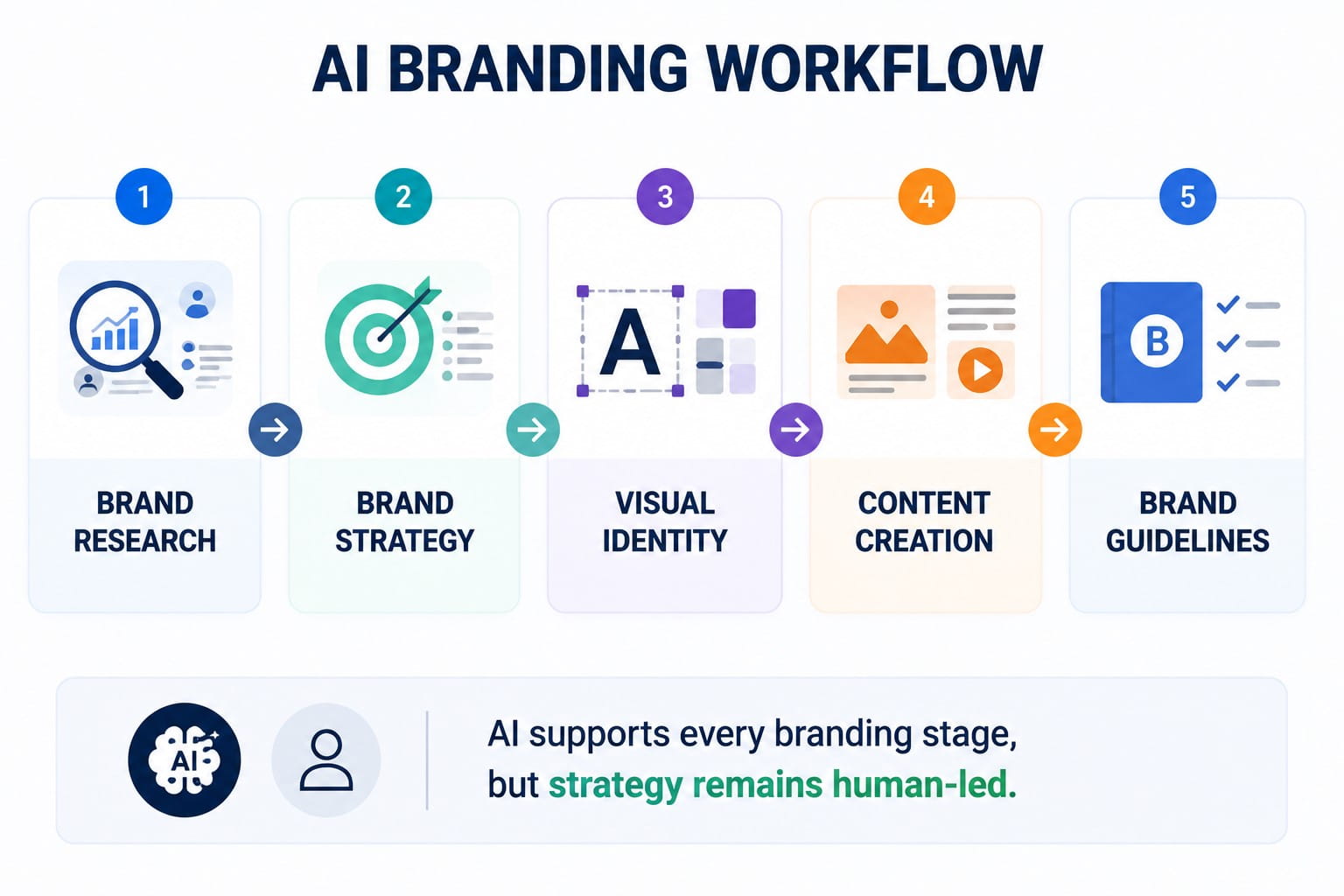
AI changes branding workflows by moving teams from manual production toward evaluation and strategic refinement. Instead of creating every element from scratch, teams can focus on improving concepts and making better decisions.
Traditional branding processes often require significant time for research, references, and early concept preparation. AI can reduce repetitive tasks by helping teams organize information and explore directions faster.
AI-supported workflows usually change several parts of the branding process:
| Workflow stage | Traditional approach | AI-supported approach |
| Research | Manual information collection | Faster pattern identification |
| Ideation | Limited initial concepts | More directions for evaluation |
| Review | Feedback after creation | Earlier comparison of solutions |
| Guidelines | Manual rule application | Easier system management |
AI also changes collaboration between designers, marketers, and business teams. Generated concepts create starting points for discussions and faster feedback cycles.
However, teams still need to evaluate AI outputs carefully. A visually strong concept may not support the intended positioning or audience expectations.
A mature AI-supported branding workflow usually depends on:
- Clear criteria for evaluating AI-generated concepts.
- Defined roles for human decision-making.
- Consistent principles across brand applications.
- Repeatable processes for future branding tasks.
The long-term value of AI comes from improving decisions rather than increasing output volume. Effective workflows use technology while keeping human judgment responsible for brand meaning.
AI for Branding: Key Benefits and Potential Challenges
AI for branding can improve efficiency across research, creative exploration, and content production. However, the value depends on how companies use these tools and whether they maintain strategic control over the final outcome.
| AI application | Practical benefit | Main challenge |
| Brand research | Faster analysis of market information | Data still requires human interpretation |
| Creative ideation | More concepts to evaluate | Generated ideas may lack originality |
| Content development | Faster messaging variations | Brand voice can become inconsistent |
| Personalization | More relevant communication | Results depend on data quality |
One of the main advantages of AI-powered branding is speed. Teams can explore more directions during early stages of development and identify patterns that may be difficult to find manually. This helps reduce repetitive work and creates more opportunities for experimentation.
AI tools are also useful when teams need to adapt branding across different channels. A consistent identity requires repeated decisions about tone, visuals, and messaging. AI can help organize these elements and support faster content production.
Before integrating AI into a branding workflow, teams should consider:
- Whether AI outputs reflect the brand’s strategic direction.
- Whether the provided inputs represent real customer expectations.
- Whether teams can maintain control over final decisions.
- Whether AI fits naturally into existing creative workflows.
However, speed does not guarantee quality. AI-generated concepts may follow common patterns because they are based on existing information. Without strong strategic input, brands risk creating identities that look polished but lack differentiation.
Another challenge is maintaining consistency. Multiple AI tools can produce different styles, messages, or recommendations. Companies need clear brand principles to evaluate outputs and prevent fragmented experiences.
The strongest results come from combining AI capabilities with human expertise. AI can expand possibilities, but people decide which ideas support the brand’s purpose and long-term direction.
How to Use AI Throughout the Branding Process + Essential Tools
AI becomes most valuable in AI brand development when it supports a clear branding workflow rather than replacing strategic decisions. Different stages of brand development require different types of assistance, from analyzing audiences to exploring visual directions and maintaining consistency after launch.
A practical approach is to connect each branding task with the right AI capability while keeping human review involved at every important decision point.
Brand Research
AI can help teams collect and organize information faster during the early stages of branding. It can identify patterns in feedback, analyze market conversations, and structure competitor information faster.
However, research findings do not automatically become brand strategy. Teams still need to determine which insights are meaningful and how they affect positioning decisions.
Examples of AI tools used for brand research:
| Tool | Purpose |
| SparkToro | Helps analyze audience interests, preferred channels, and sources of influence. |
| Brandwatch | Supports consumer research through social listening and market sentiment analysis. |
| Exploding Topics | Helps identify emerging trends and growing market categories. |
The main advantage of using AI technologies for brand design research is efficiency. Teams can review larger information sets and identify potential directions before committing resources to development.
The biggest mistake is treating AI-generated observations as final conclusions. Data becomes valuable only when teams understand the context behind it and connect findings to customer expectations.
Brand Strategy
Understanding the role of AI in brand strategy helps companies use positioning ideas, messaging options, and communication directions more effectively. However, strategy depends on decisions that require understanding business goals, customer motivations, and competitive conditions.
A strong brand is not created by selecting the most attractive AI-generated option. It is created by choosing a direction that reflects company purpose and gives customers a clear reason to choose it.
AI can support parts of the brand design process by helping teams explore concepts and organize creative possibilities. The final decisions still depend on strategic judgment and a clear understanding of the audience.
Effective AI-assisted brand strategy usually focuses on:
- identifying customer problems;
- clarifying the brand promise;
- developing consistent messaging;
- defining a recognizable voice.
This approach helps companies use AI as a decision-support tool rather than a replacement for strategic thinking.
Examples of AI tools used for brand strategy:
| Tool | Purpose |
| Miro AI | Helps teams organize strategy workshops and visualize brand frameworks. |
| Milanote | Supports visual planning for brand concepts and strategic direction. |
| Ideanote | Helps teams collect, evaluate, and develop strategic ideas. |
Brand Naming and Messaging
AI tools can accelerate naming and messaging exploration by generating multiple options quickly. This is useful during early brainstorming when teams need to evaluate different directions before selecting a final approach.
However, more options do not automatically create stronger brand names. A successful name needs to fit the audience, communicate the right associations, and remain distinctive in the market.
Examples of AI tools used for naming and messaging:
| Tool | Purpose |
| Namelix | Helps generate brand name ideas based on business concepts. |
| Looka Business Name Generator | Supports early naming exploration connected with brand identity concepts. |
| Wordtune | Helps refine messaging variations and improve communication clarity. |
Strong AI-assisted naming requires:
- clear brand positioning;
- defined audience expectations;
- competitive context;
- human evaluation.
The same principle applies to messaging. AI can create variations of headlines, taglines, and brand statements, but teams must decide which messages accurately represent the company and create meaningful differentiation.
Book a Call
Visual Identity
Generative AI for brand development has changed how companies explore creative directions by making concept generation faster. Teams can create moodboards, experiment with styles, and compare different visual approaches before developing a final identity system.
However, visual variety does not equal brand clarity. A strong identity requires decisions about meaning, consistency, and audience perception.
| AI supports | Human controls |
| Midjourney | Helps explore visual concepts, styles, and creative directions. |
| Adobe Firefly | Supports AI-assisted image generation inside creative workflows. |
| Leonardo AI | Helps create visual concepts and experiment with design variations. |
During early visual exploration, AI for graphic design can help teams compare creative directions faster. Human expertise remains necessary to evaluate whether ideas support brand positioning.
Professional brand identity design requires more than attractive visuals. It connects design choices with business goals, customer expectations, and long-term recognition. Intelligent brand design combines AI-assisted exploration with strategic decisions that help companies create more meaningful and consistent identities.
Content Creation
AI can support content creation by helping teams adapt brand messages across different channels while maintaining a consistent communication style. These tools are useful for generating drafts, testing variations, and adjusting content for different audiences.
However, content volume does not replace brand clarity. AI-generated materials still need review to ensure they reflect the company’s positioning, tone, and customer expectations.
AI can support digital branding workflows through:
- adapting messages for different platforms;
- creating content variations;
- maintaining consistent terminology;
- testing different communication approaches.
The strongest results come when teams provide clear brand inputs before generating content. Without defined guidelines, AI may create materials that are grammatically correct but disconnected from the brand identity.
Companies should treat AI-generated content as a starting point for refinement rather than a final output. Human review remains essential for ensuring accuracy, relevance, and consistency.
Examples of AI tools used for content creation:
| Tool | Purpose |
| Canva AI | Helps create and adapt branded visual content across formats. |
| Jasper | Helps create brand-aligned content using defined communication guidelines. |
| Descript | Supports content editing and adaptation for different media formats. |
Brand Guidelines
Brand guidelines help companies maintain consistency after identity creation. Reusable design systems support this process through shared components and clear principles. As organizations create more content across channels, these systems help keep visual and verbal decisions aligned.
AI can support this stage by organizing brand information, creating reusable content structures, and helping teams apply established rules more efficiently.
Examples of AI tools used for brand guidelines:
| Tool | Purpose |
| Frontify | Helps teams manage brand guidelines and organize brand assets in one system. |
| Bynder | Supports digital asset management and consistent brand content distribution. |
| Zeroheight | Helps teams document and maintain design systems and brand standards. |
A structured AI-assisted guideline process can include:
- approved messaging examples;
- visual usage principles;
- tone and communication rules;
- reusable creative prompts.
The role of AI is not to define the brand system independently. It helps teams manage and apply decisions that have already been strategically established.
Strong brand experience design depends on consistency across every customer interaction. AI can make this process easier by supporting repeatable workflows, but companies still need clear standards that guide every application.
How to Get the Most From AI Tools for Branding
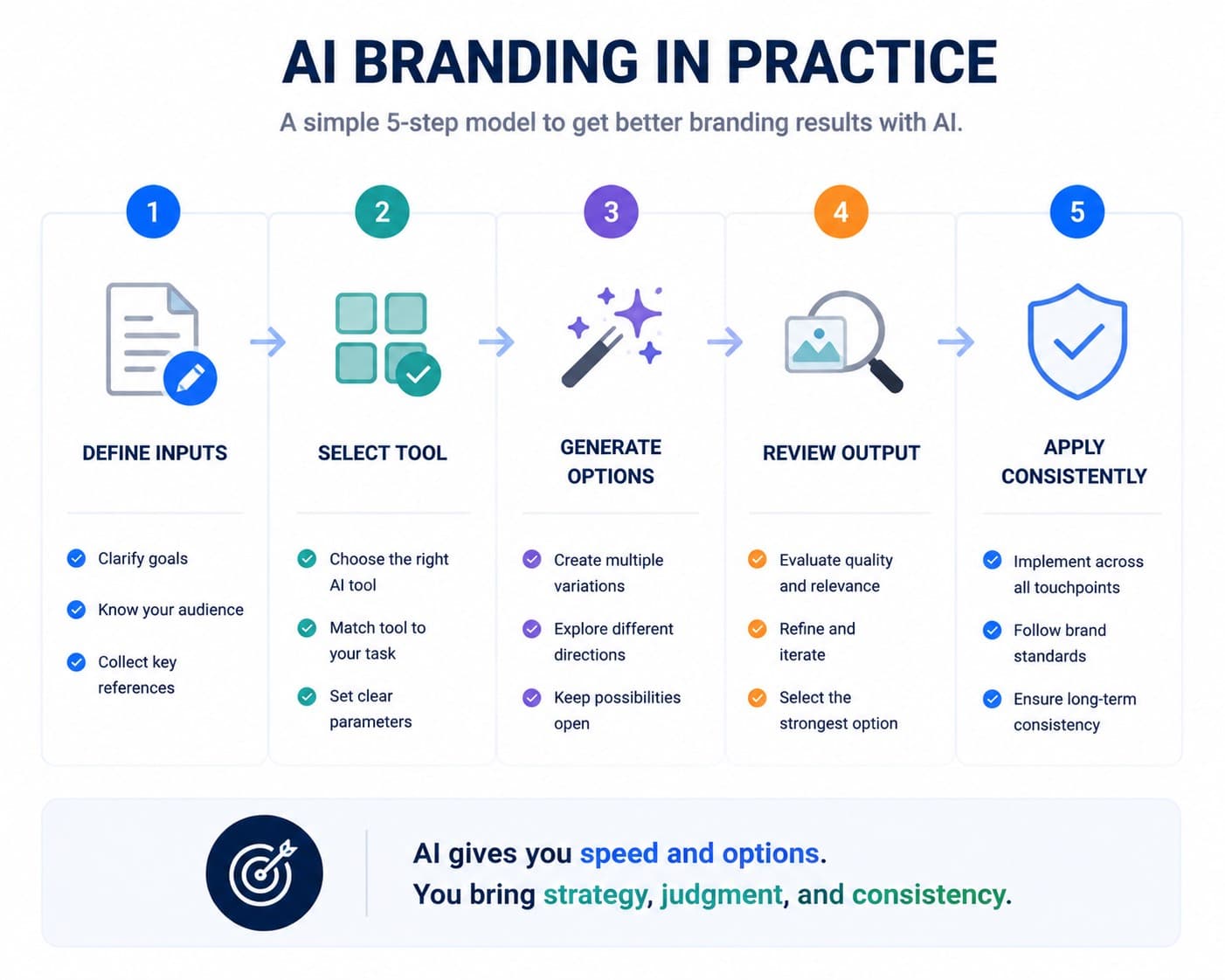
The effectiveness of AI branding tools depends on how companies integrate them into their workflow. Understanding how to use AI in the branding process helps companies choose workflows, define inputs, and maintain control over final decisions. Clear objectives, strong inputs, and human review help teams avoid generic results and create more valuable outcomes.
Define Brand Inputs Before Using AI
AI outputs depend heavily on the information provided. Teams should establish their audience, positioning, values, and communication goals before asking AI to generate ideas.
Clear inputs help AI produce options that are closer to the intended direction.
Choose Tools Based on the Branding Task
Different AI capabilities support different parts of brand development. Companies should select tools according to the problem they need to solve rather than searching for one universal solution.
For example:
- research tools support market understanding;
- visual tools support concept exploration;
- content tools support messaging development;
- workflow tools support consistency.
Keep Human Oversight in the Process
AI can generate alternatives quickly, but it cannot determine whether an idea represents the right strategic direction.
Human review is needed to evaluate:
- relevance to the audience;
- differentiation from competitors;
- consistency with brand goals;
- long-term usability.
Review Outputs Against Brand Strategy
A visually attractive or well-written result does not automatically strengthen a brand. Teams should compare AI-generated materials against their positioning, customer expectations, and communication standards.
This prevents companies from creating disconnected assets that lack a common identity.
Build Repeatable AI-Assisted Workflows
The most effective companies do not use AI as an isolated experiment. They integrate it into repeatable processes where tools support research, creation, review, and ongoing improvement.
Integrating AI into brand development works best when technology improves efficiency while strategic decisions remain controlled by experienced professionals.
Conclusion
AI branding tools can help companies accelerate research, explore creative directions, and maintain consistency across different brand touchpoints. However, stronger results come from using AI as part of a structured branding process rather than relying on automation alone.
The most effective approach combines AI capabilities with human strategic thinking. Companies still need to define their positioning, evaluate creative decisions, and ensure that every brand element supports a clear purpose.
AI can make branding workflows faster and more scalable. Strong identities still depend on decisions about customers, differentiation, and long-term perception.