

In 1994, three years after the first ever website was published, there were fewer than 3,000 websites online. Just having a website meant that you stood out.
Fast-forward to 2025 and nearly 180,000 new websites are created each day alone.
Much of this growth is thanks to the fact that website design has become much more accessible. With a theme or template, you can create a “new” business website each day.
That might be a route you can take to getting a website, but will it set you on the path of scalable growth? Should you go custom and stand out, or save time with a premade theme?
This post unpacks the key differences, pros, and cons behind each option so that your next move isn’t just stylish, but strategic.
What Is Custom Website Design?
Custom website design is when you create a unique website from scratch without the help of premade layouts. This method gives you complete control over the aesthetics, layout, navigation, and user experience (UX), allowing you to tailor the design specifically to your brand’s goals, functionality requirements, and target audience. You also have much more creative freedom to incorporate your brand design and interactive and visual elements.
What Is Template Website Design?
Template website design uses pre-designed website templates and themes as layouts and page structures to create websites. As such, you have limited customization ability. The changes that you can make are mostly cosmetic like changing the background colour or image.
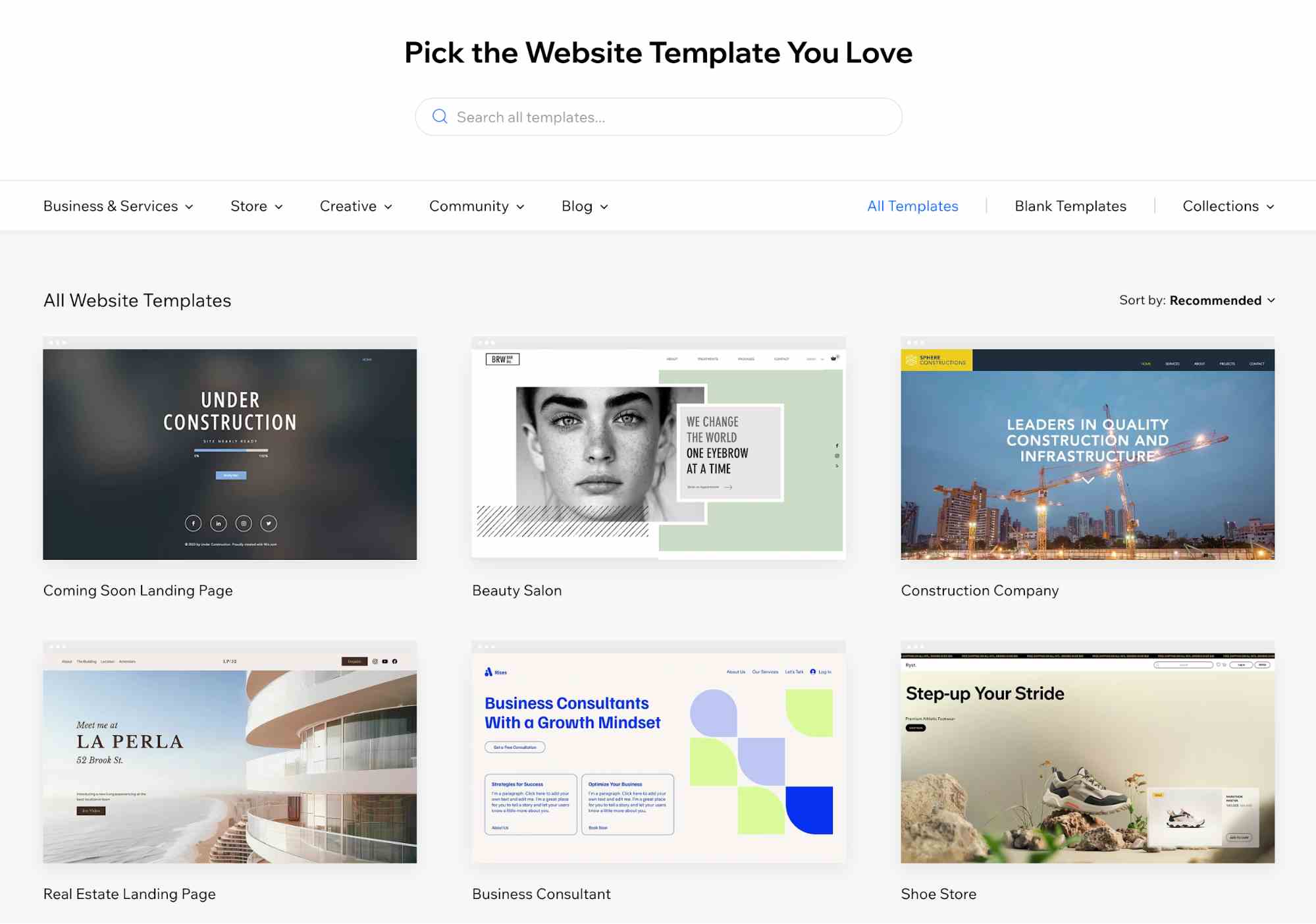
Source: Wix
Custom Design vs Templates: Key Differences Explained
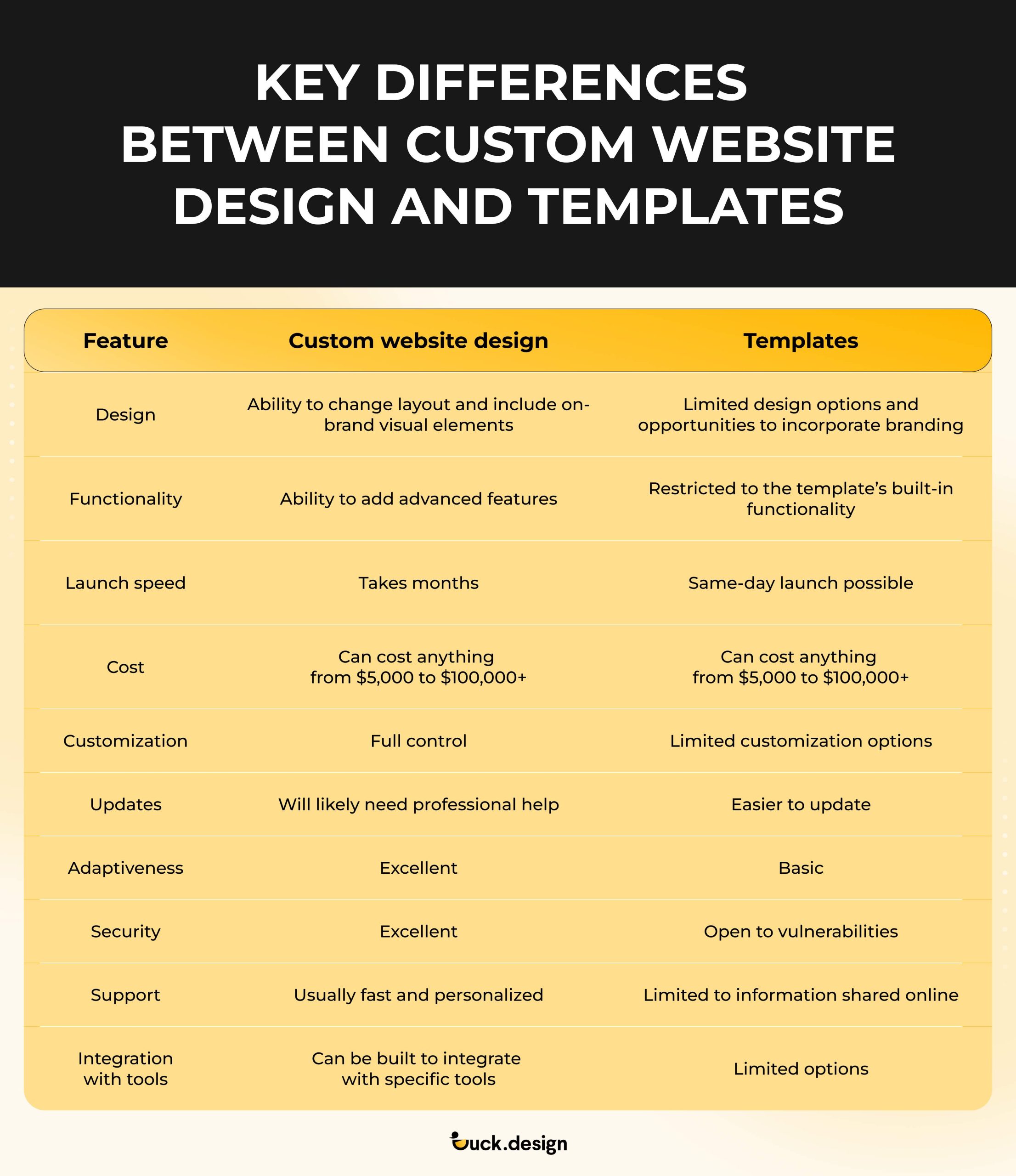
It’s not just the method but also the results that are different. Here’s how custom website design vs template design compare:
Design
The design process is one of the main differences between website templates and custom design. With custom website design, you use your brand identity and target audience as guidelines. The layout and visual elements added to it are carefully chosen to match the brand’s identity, advertising design, and its target audience’s preferences.
With template design, the premade website theme that you’ve selected will guide your design decisions. The overall layout will remain mostly unchanged. Your design tasks will basically be restricted to adding standard visual elements like a business logo.
Functionality
With custom design, you can add a whole lot more functionality. You can, for example, add advanced features like an exclusive interface, a user portal, or booking system.

Source: 99designs
On the other hand, if you want to improve the built-in functionality of your website built with the help of a template, you’ll need to rely on plugins. Even with third-party tools, you’ll have limited control over the features that you can add.
Launch speed
As you’d expect, custom websites take more time to develop. The main development of the website can take a few months. Then, you still need to add to that time those weeks needed to set goals, find a custom web design company, design mockups, and review the design.
Using a template, you can have your site up and running within a matter of days. In fact, a same-day launch is even possible.
Cost
Template website design remains the cheaper option. To give you an idea, DesignRush estimates that template-based design will cost you between $1,000 and $5,000.
However, custom design can cost you anything between $5,000 to over $30,000. Not only is it far more expensive, but its pricing is also more difficult to estimate as factors like your industry, special features requested, and complexity of the design can have a significant impact on the cost.

Source: GoodFirms
Read Also: How Much Does Website Design Cost and How to Plan Your Budget Wisely
Customization
While template design offers some customization, you’re limited to making basic changes. You can, for instance, rename menu items, but might not be able to change the menu style.
However, as the name implies, custom web design gives you total control over the final looks. On top of that, you can also customize aspects like the site structure and navigation to guide website visitors towards specific actions.
Schedule a call
Updates
Updating your custom website will be more challenging. While you have full control over updates, the manual updates will be your responsibility. As such, you’ll likely need to have an in-house web developer who can tackle future website improvements or outsource this task to a website design agency.
Maintenance is simplified with templates. For example, if you’re using a platform like WordPress or Shopify, automatic updates are often included.
Adaptiveness
Custom website design typically incorporates adaptive design solutions as part of the design strategy. You can even take it one step further to prioritize mobile usability based on your actual audience’s devices and browsing behaviour.
If you’re using a website theme, it’s not a given that it will be mobile responsive. Even if they are built to be responsive, they rely on generic layout rules aimed at general audiences. As such, it might ignore accessible website design best practices like strong colour contrasts.
Read Also: Adaptive vs Responsive Design: Which One Should You Choose?
Security
Custom-coded websites have fewer vulnerabilities, making them the more secure option. Plus, as they usually rely on fewer third-party integrations, your exposure to bugs are further reduced.
On the other hand, with templates, you’re more exposed to risks. In fact, as thousands of websites are using the same template, attackers often design tools to exploit these vulnerabilities specifically. This risk becomes greater if you’re using a third-party plugin or outdated theme.
Support
One of the reasons why custom web design is more expensive is because it also includes dedicated support, at least for the duration of the website build. Depending on the Ts and Cs of your agreement, support after your website has been launched might come at an additional fee. That said, you’ll still receive personalized help, even if it means at an extra cost.
With the other route, you’ll mostly need to turn to forums or chatbots for support. This means that you’ll typically have to wait longer for a response and, when you receive it, the answer will be less tailored to your specific issue.
Integration with tools
Custom designed websites can be built to integrate with a specific marketing platform or third-party tool from the start.
If you choose to use a template, you’ll have to settle with the set list of tools with which it integrates. That said, it generally integrates well with popular tools, but more advanced integrations will be off the cards.
Pros and Cons of Website Templates vs Custom Builds
Many of these differences also mean that each option has its own advantages and disadvantages to consider. To understand custom website vs template design better, here’s a summary of their benefits and drawbacks.

✅Pros of Custom Builds
Bespoke design
You’ll receive a one-of-a-kind website that has unique layouts, fonts, color schemes, interaction design, and other graphics. What’s more, you also have the opportunity to align it with your branding and identity.
The fact that you have complete control over your layout is especially useful. This means that you manage the user experience too to create user-centered design which will positively impact your website conversion.
Custom features
In addition to the visual aspect of your website, you can also design its functionality to meet your exact specification. You can, for example, request a visual product configurator, calculator, or booking calendar.

Source: KitchenAid
Scalable structure
Custom sites are designed with your brand’s long-term needs in mind. Plus, their dynamic website structure makes it easier to expand and integrate with other systems which mean that your website can grow alongside your business.
❌Cons of Custom Builds
Cost
Custom websites can cost as much as six times more than one built from a template. You’re essentially paying for the time and skill.
Longer development time
On average, custom websites take months to launch. Web portals and SaaS websites take even longer and can require up to 30 and 48 weeks respectively.
Maintenance
As mentioned earlier, custom websites require ongoing maintenance which will be your responsibility. Whether it’s a nice-to-have website enhancement or crucial fix, you’ll need a website developer’s help from time to time after your website is live.
✅Pros of Website Templates
Variety of tested layouts
You might lack the high level of customization, but you’ll still have access to hundreds of layouts that could work for your industry and business goals. Creating a lead generation website, for example, is a matter of searching for a template that’s been designed specifically for that purpose.

Source: Envato
While other businesses will use that template too, it offers the upside that it’s been tested extensively.
Lower cost
As this route is a lot less labour-intensive, it’s far more affordable. According to Shopify, the DIY approach can cost you as little as $200 per year. In fact, you might even be able to find a free template.
Beginner-friendly
In addition to being budget-friendly, templates are also beginner-friendly. Most templates feature a drag-and-drop editor which means that you can design a basic website without any coding skills and much faster.
❌Cons of Website Templates
Limited functionality and customization
While templates and themes are convenient, it means you have limited control over which elements you can change and functions that you can add. As such, you’ll likely end up with a basic website that looks and feels similar to thousands of other sites, maybe even that of your direct competitors.
Less secure
Template websites can still be secure with proper plugin management and good hosting, but shared resources and third-party dependencies mean they come with more inherent risks.
Poorer performance
Templates generally deliver a slower performance. As they’re not optimized from the ground up, your web pages will load slower. Responsiveness might also be impacted. It’s also not built upon technical SEO best practices which could hurt your website traffic too.
Tell us about your brand
How to Know If You Need a Custom or Template Website Design?
Your budget, business goals, and technical needs will determine whether custom web design services justify the timeframe and cost. The following questions will give you insight into these factors to help you decide:
- What’s my budget for this website?
- Do I need unique features?
- How important is custom branding for my business?
- Do I plan to invest in SEO?
If you have a well-established brand enjoying rapid growth and you plan to use SEO to fuel that growth, custom website design services will give you the flexibility needed. In fact, if you have complex functionality, it will be the only choice.
If you’re a small business with a limited time budget that needs to get online quickly, a template will do. It’s also a better choice if the rest of your marketing design (e.g. your social media or packaging) is still evolving. A professional theme or template can give you a decent web presence without a big commitment.
Duck.Design: We Bring Out the True Essence of Your Brand with Custom Web Design
Before you dismiss custom website design because of its slower launch time or higher costs, consider Duck.Design’s web design services first. We created comprehensive service packages to speed up the process and make the pricing more predictable and affordable. Where it will take you a month or longer just to hire a designer, signing up to our subscription that gives you access to a team of pre-vetted candidates takes a click.
Plus, to streamline the custom web design process further, we’ve included related services like website icons/graphics, basic photo editing, UI/UX design, and videos in the same plan too. After all, what would a custom website be without custom illustrations?
Creating a website from scratch is an important step for your business. To ensure that everyone on your team can share their input, every plan includes unlimited requests and revisions.